
Running a Lee County Sex Offender Check
The official starting point is the Florida Sexual Offenders and Predators Search, maintained by the Florida Department of Law Enforcement. Lee County does not run a second public registry that competes with it. Local registration information moves to FDLE, which places public data in one statewide search. That division matters when a result is missing or seems wrong: FDLE operates the public database, while the registering local agency may hold the newest verification detail.
Use the registry for safety awareness and address-based notice. Do not treat a result as a full account of arrests, charges, or case outcomes. FDLE expressly separates the registry from its criminal-history search product. For broader county record context, the Lee County criminal history overview explains how court, arrest, and state repository records fit together.
The separate FDLE Wanted Persons Search illustrates why a warrant result and a registry profile must not be confused.
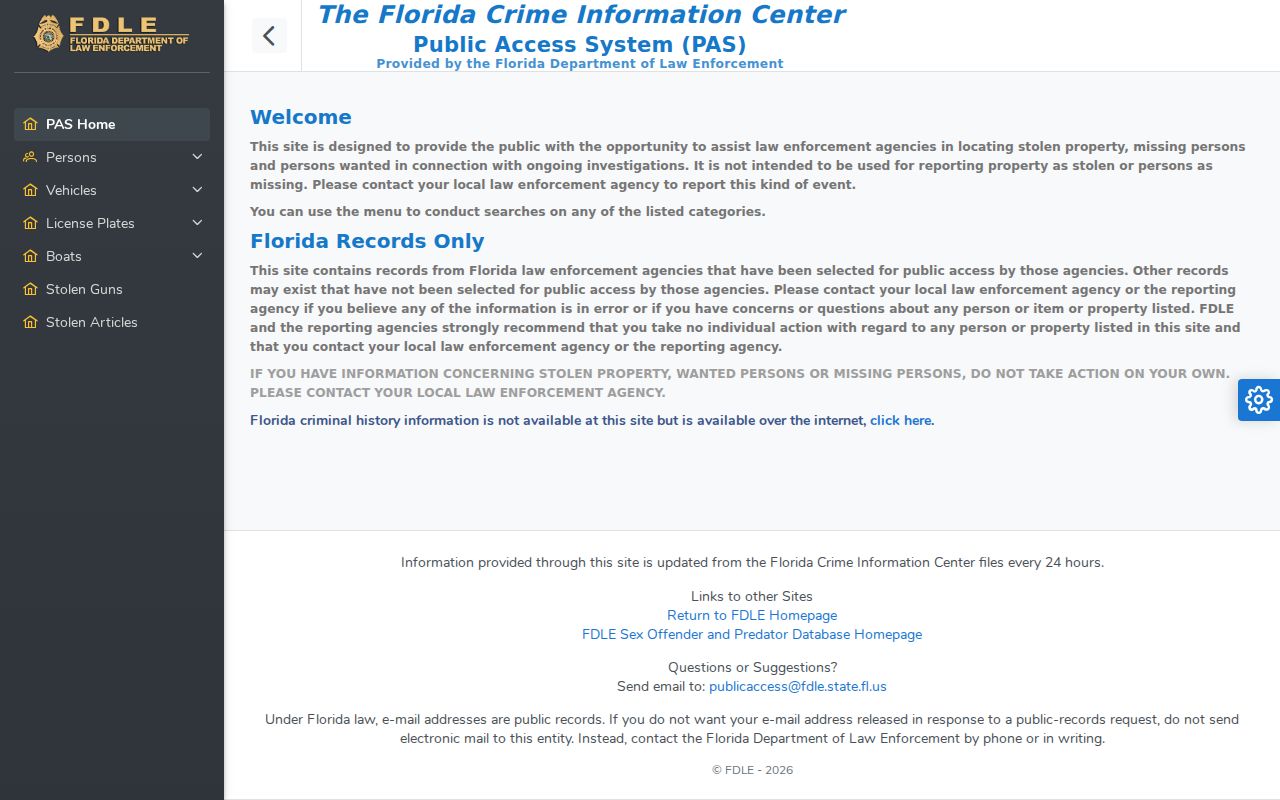
Use the offender registry for registration status and the wanted-person tool only for its distinct warrant purpose.
Lee Registration Data Goes Statewide
Lee County law enforcement collects and verifies local registration facts, then FDLE publishes eligible information. The flow is local registration › agency verification › FDLE statewide profile. A new address or status change may therefore involve both offices. If an entry appears inaccurate, record the profile details and contact FDLE or the registering agency rather than trying to correct it through a court-search screen.
This flow also explains why there is no reliable “Lee-only” master list to search instead. The statewide registry is continuously updated and lets users apply county, city, ZIP code, and radius filters. Lee residents receive the same official profile fields and status terms as users elsewhere in Florida.
The FDLE search information screen displays the registry controls.
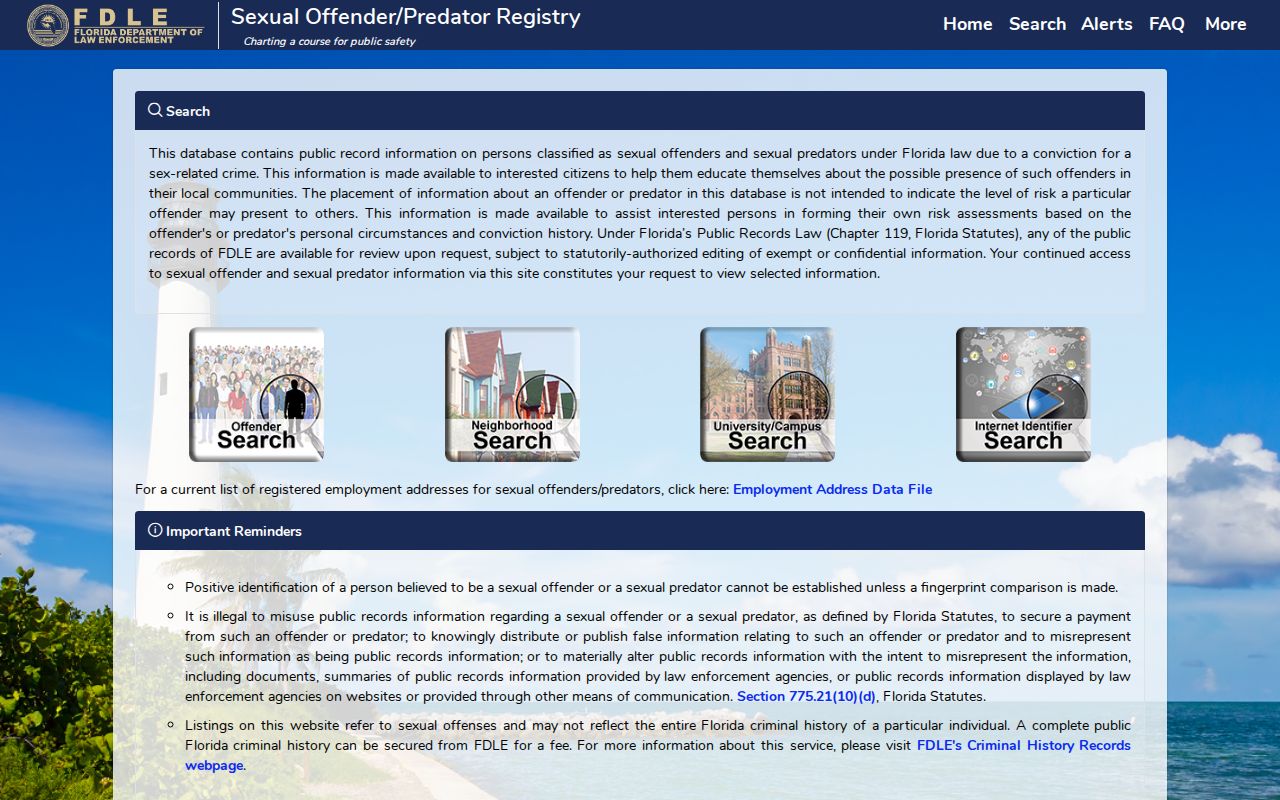
Those controls let a reader narrow a broad Lee County search before opening a profile.
Searching Lee County Registry Records
Begin with the most reliable facts available. A full name helps distinguish people with similar names, while a neighborhood search works best with a complete street location and a practical radius. The expanded form can filter offender type, status, and whether the record is in state. It also offers list or flyer views and small profile images.
- Choose a person search for a known name or Neighborhood Search for an area.
- Enter the strongest identifiers, then add city, county, ZIP code, or radius details when relevant.
- Review the result list for identity, designation, address, and current status before opening a profile.
- Confirm the profile’s verification and qualifying information, then use the reporting contacts if data appear wrong.
| Field label | Type | Required | Options or format |
|---|---|---|---|
| First Name | Text | No or unspecified | Name search |
| Last Name | Text | Needed for a useful name search | Name search |
| Address | Text | For neighborhood search | Street address |
| City | Text | For neighborhood search | Florida municipality |
| ZIP Code | Text | Optional alternative | Five digits |
| Radius | Dropdown | Yes for radius search | 1/4, 1/2, 1, 2, 3, 4, or 5 miles |
| Search / Reset | Buttons | No | Submit or clear the form |
Florida Alerts Around Lee Addresses
The free Florida Offender Alert System adds monitoring to a one-time Lee County registry search. A user can follow more than one address or track a specific registered person for address changes. That makes the tool useful for households, caregivers, and people who want notice without repeating the same neighborhood query.
An alert is a prompt to reopen the official profile. It does not prove a new offense, and it should not be read as a risk score. Florida’s public labels and status fields have legal meanings, not predictions about future conduct.
Address monitoring and person monitoring answer different questions. The first watches for registration changes near a place in Lee County. The second follows one selected profile when its registered address changes. Neither mode confirms that the person is present at a location at a given moment. Recheck the current FDLE profile before relying on an older email, saved flyer, or printed result.
The Florida Offender Alert site presents the free signup route.
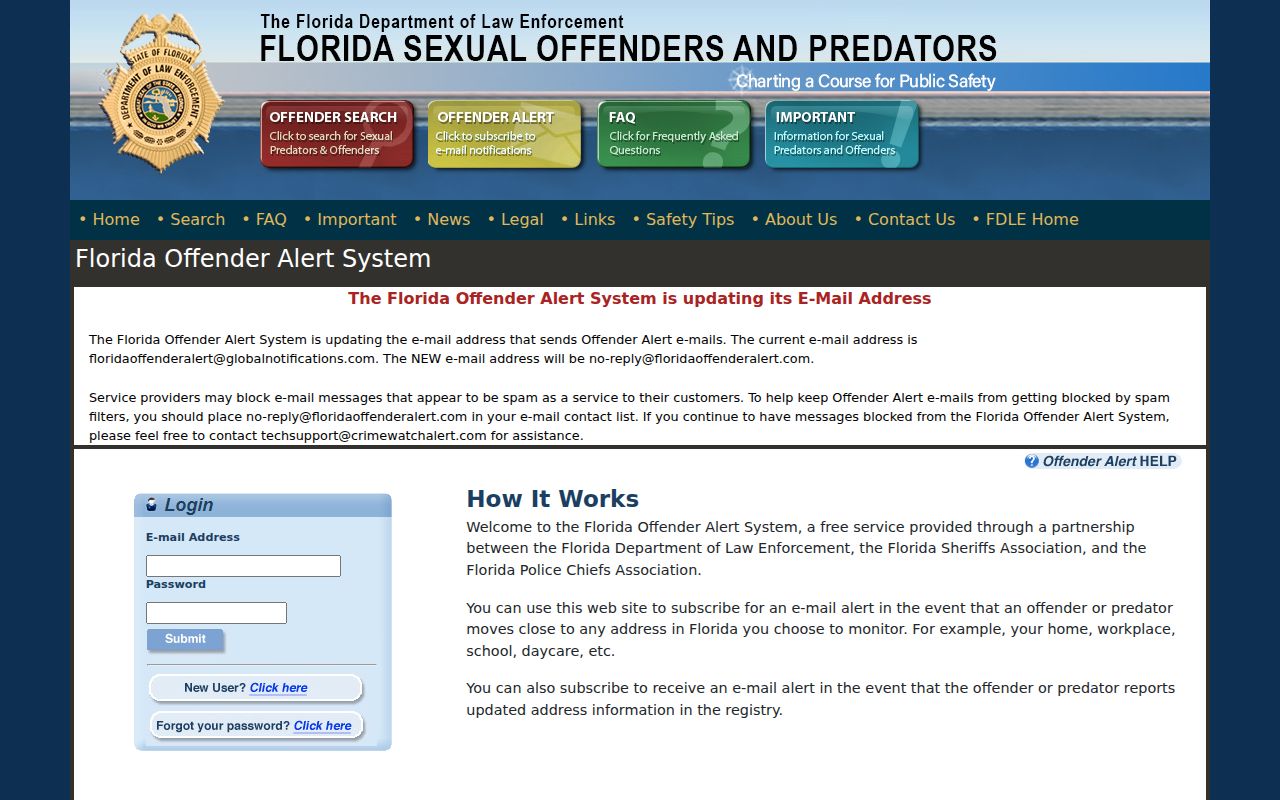
Alerts extend the FDLE search by notifying users when tracked registration information changes.
What a Lee Registry Profile Shows
Read the whole Lee County profile, not just a photo or map pin. Names and physical descriptors help confirm identity. The designation, qualifying offense, adjudication information, addresses, supervision, and verification fields give legal and current-status context. An “absconded” label means the person has failed to maintain required contact; it is a report-to-authorities signal, not permission to approach.
| Identity | Legal name, aliases, date of birth, photo, and physical descriptors |
|---|---|
| Designation | Florida sexual offender or sexual predator classification |
| Qualifying record | Offense, jurisdiction, adjudication, and sentence information published by FDLE |
| Locations | Reported permanent, temporary, transient, school, or work information when public |
| Status | Registration, custody, supervision, absconded, and verification details |
Registry data can be incomplete or change quickly. A court disposition supplies detail that a short qualifying-offense line may not show. The registry is one public-safety record, not a substitute for the Lee Clerk docket or FDLE criminal-history product.
NSOPW Extends Lee Registry Searches
A move, past address, or family connection may cross Florida’s border. The U.S. Department of Justice National Sex Offender Public Website searches participating jurisdictions through one federal interface. Use it after the Florida search when the person or location may involve another state, territory, tribal jurisdiction, or the District of Columbia.
NSOPW is an added search layer, not a new source record. Each participating jurisdiction remains responsible for its data. Open the underlying jurisdiction’s profile and follow its correction or reporting instructions.
The national registry search shows that cross-jurisdiction layer.
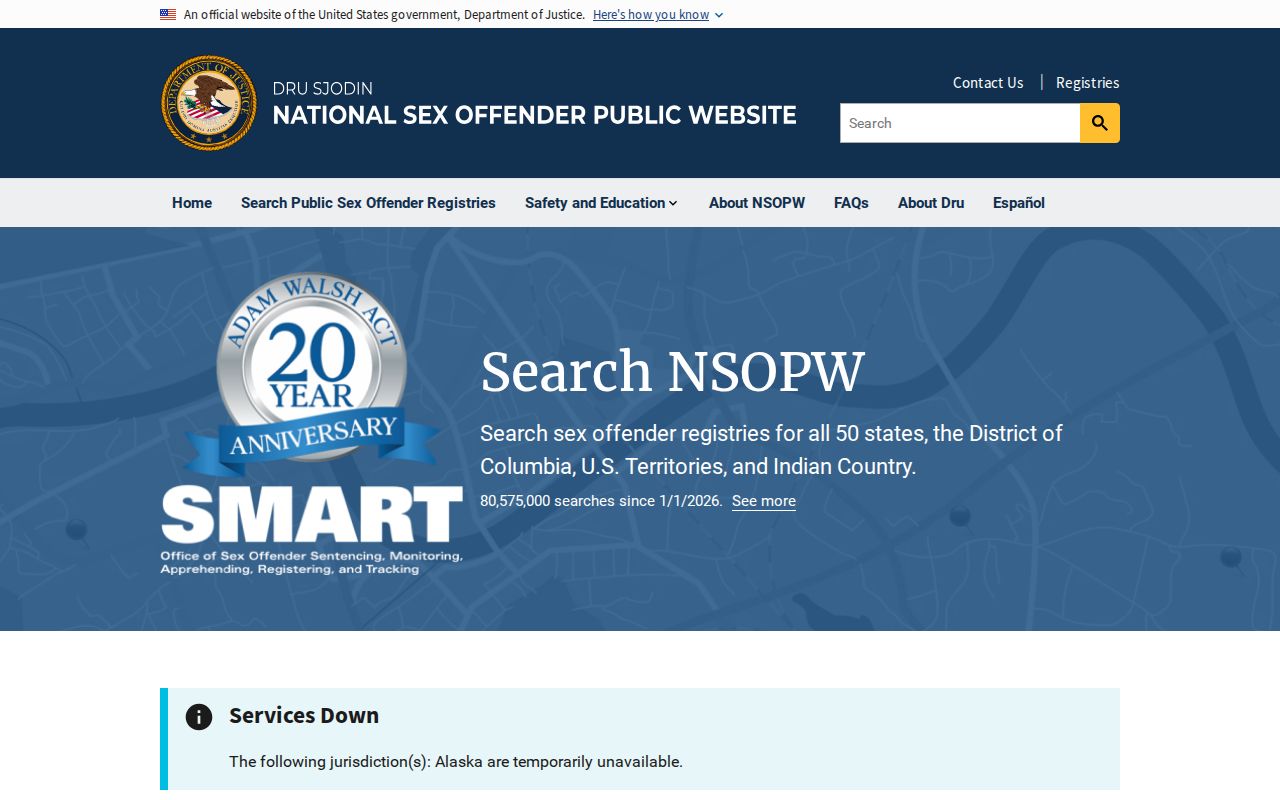
It is most helpful when a Lee County name or address is only one part of the search.
Registration Requirements and Levels in Florida
Florida uses statutory designations rather than the federal SORNA tier labels shown in some national explanations. Registration is generally for life, subject to narrow petition or other relief rules. Sexual offenders commonly report twice each year unless the qualifying status calls for quarterly reporting. Predators, specified offenders, and qualifying juvenile registrants report quarterly.
| Florida category | Usual duration | Reporting pattern |
|---|---|---|
| Sexual offender | Generally lifetime, with narrow relief rules | Commonly semiannual; some qualifying statuses require quarterly reporting |
| Sexual predator | Generally lifetime | Quarterly |
| Specified offender or qualifying juvenile registrant | Depends on the governing provision | Quarterly where Florida law requires it |
Florida Statute section 943.0435 sets core sexual-offender duties. Section 775.21 governs the predator framework and community notification. The public designation does not state that FDLE has predicted future behavior.
Verification frequency is only one part of compliance. Florida law also addresses changes to residence, vehicles, employment or school information, internet identifiers, travel, and other required facts. The public profile condenses those duties into status fields. A reader should not decide that a person is compliant or noncompliant from one old address line alone; the responsible agency must assess the full registration record.
The Florida registration statute is the primary source for those duties.
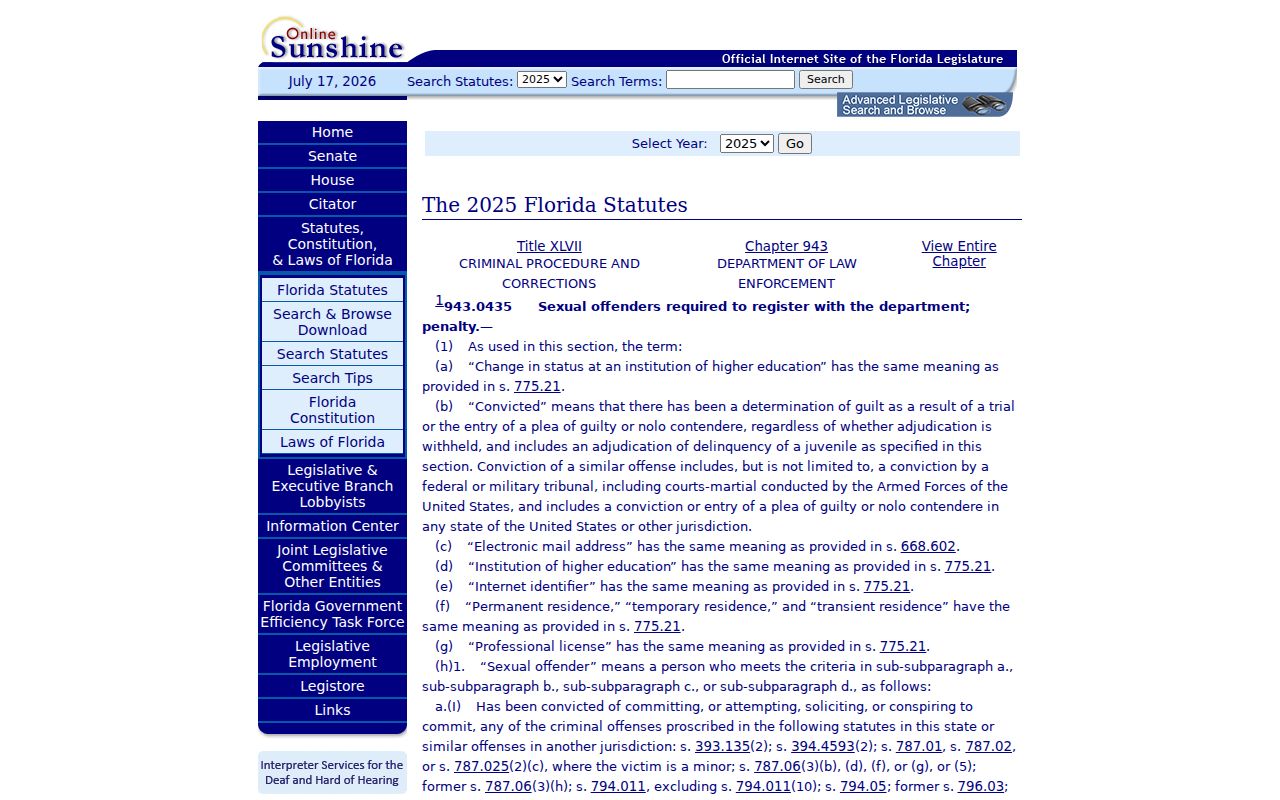
The statute gives the legal frame behind the shorter labels seen in a public profile.
Lee Registry Residence Limits
Florida Statute 775.215 includes a 1,000-foot residence restriction for defined qualifying circumstances. It is not a blanket rule for every person listed in Lee County. The offense date, conviction, victim age, classification, and other statutory facts can matter. A map pin alone cannot settle whether a residence is lawful.
Questions about a specific registered address should go to law enforcement or qualified counsel. Community members should report facts, not attempt their own enforcement. This distinction prevents a registry search from turning into an unsupported claim about a person’s compliance.
Report Lee Registry Errors Safely
FDLE provides the public hotline 1-888-FL-PREDATOR for community information and reports. An inaccurate profile can also be raised with FDLE or the local registering agency. Keep the name, profile link, field at issue, and the source of the correction together. Public email to the registry bureau may itself become a public record; the hotline is the anonymous reporting route.
If a profile says “absconded,” do not approach the person. Contact law enforcement. The same rule applies to suspected noncompliance: report the information and let the responsible agency verify it. Lee’s Wanted Fugitives page is selective publicity, not a complete registry or warrant-clearance tool.
The official wanted-fugitives page illustrates that narrower local function.
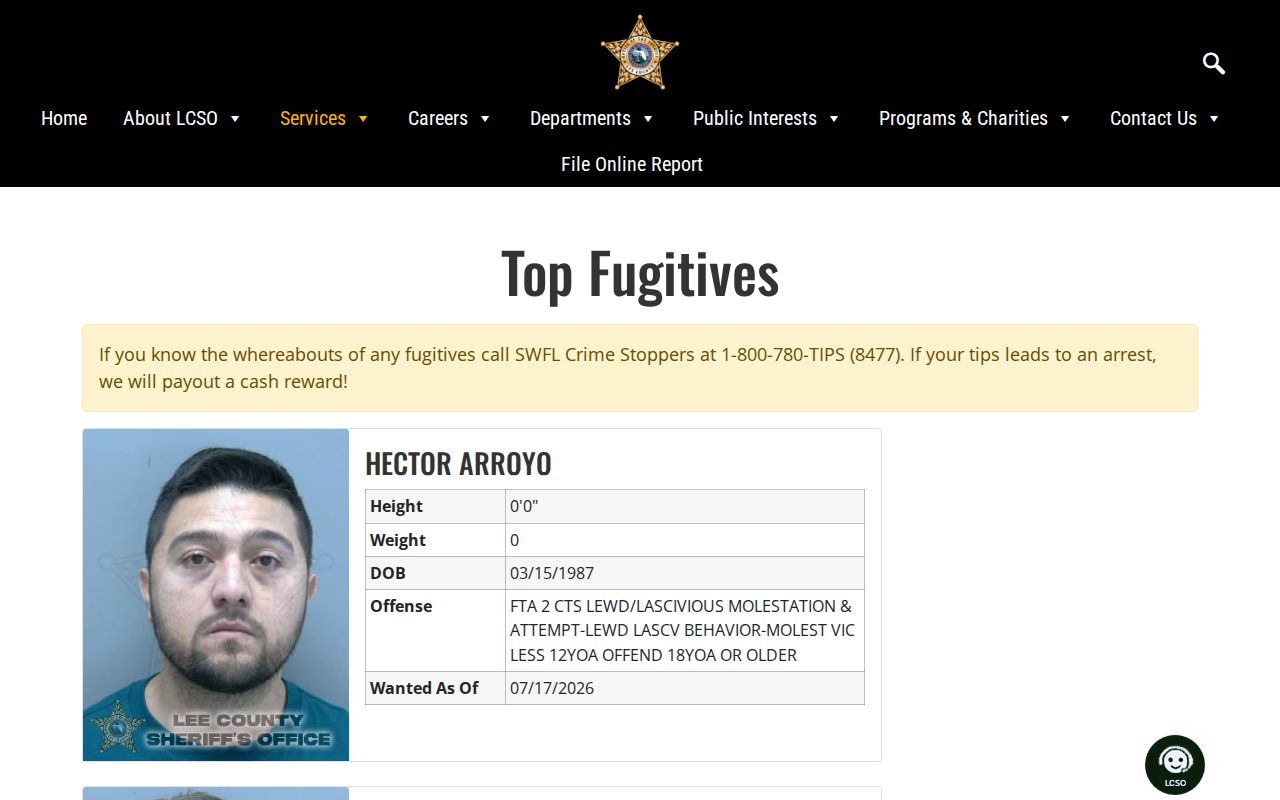
Registry status questions still belong with FDLE and the registering agency rather than a selective publicity list.
Lawful Use of Lee Registry Records
Florida publishes registry information for awareness and safety planning. Section 775.21 calls for appropriate community notification and specifies notice to licensed daycare centers and schools within one mile for a predator. The notice system does not authorize retaliation, exclusion outside the law, or contact with a registrant’s household.
Use registry information lawfully: The FDLE registry warning and Florida’s section 775.21 framework do not permit registry information to be used to harass, threaten, intimidate, or facilitate a crime. Misuse can be criminal. Report a concern to FDLE or law enforcement instead of confronting anyone.
Keep the result in proportion. Confirm identity, check the date and status, and use official contacts when something does not match. For case outcomes tied to Lee County charges, consult the Lee County criminal court case records rather than guessing from the registry entry.