
Arrest History in Lee County
The Lee County Sheriff’s Office, Cape Coral Police Department, Fort Myers Police Department, Florida Highway Patrol, and other agencies can make arrests here. Bonita Springs contracts with LCSO for policing. After a custodial arrest, LCSO central booking creates the intake entry, photograph, fingerprints, charge data, bond information, and custody status. The arresting agency still holds its incident or probable-cause report.
An arrest history is a set of events, not a verdict. A booking charge records what was asserted at intake. The State Attorney later decides whether to file a charge, and the Clerk records what the court does. Lee County sources may differ because of timing, amended charges, release, dismissal, sealing, or an event that never becomes a filed case.
Lee County Booking Search
The official LCSO booking search is the first place to check recent custody. It is built for booking and jail status, not a complete lifetime Lee County arrest history. Search with the most exact name available, then compare booking date, agency, charges, and status with facts already known.
The sheriff’s booking source also provides a useful view of how Lee County custody information is presented.
A result can roll off a current roster after release or transfer. No result does not prove that an arrest never occurred, so older events require an agency request, court search, or FDLE check. The Android Lee County Sheriff, FL app also advertises Arrest Search and crime mapping. Those tools are available on the sheriff’s website too, so the app is an extra route rather than the sole source.
How to Look Up Lee County Arrests
Start with the channel that matches the age and scope of the event. Keep the spelling, date, arresting agency, incident number, and booking number as you move between systems. These keys prevent a loose name match from being treated as one person’s record.
- Search the LCSO booking and official arrest tools for recent Lee County entries and custody status.
- Ask LCSO Central Records or the arresting city police department for the incident or arrest report.
- Search Lee Clerk CRI to learn whether prosecutors filed a case and how the court resolved it.
- Use the FDLE Instant Florida Criminal History Search for a paid statewide public name check.
- Submit a focused public-record request or call the custodian when the online sources do not answer the question.
- Switch to FDC Offender Search only after a person has moved into Florida state custody or state supervision.
For custody questions, LCSO is the direct source; county jail information is available at 239-477-1700. For the statewide fingerprint-supported arrest cycle and reported disposition, FDLE holds the central Florida file. Cape Coral Police and Fort Myers Police route their own reports through city records channels. Sanibel Police, Florida Highway Patrol, FGCU Police, and Port Authority Police likewise remain custodians of their agency reports, even when LCSO handled the booking.
Lee County Arrest Report Requests
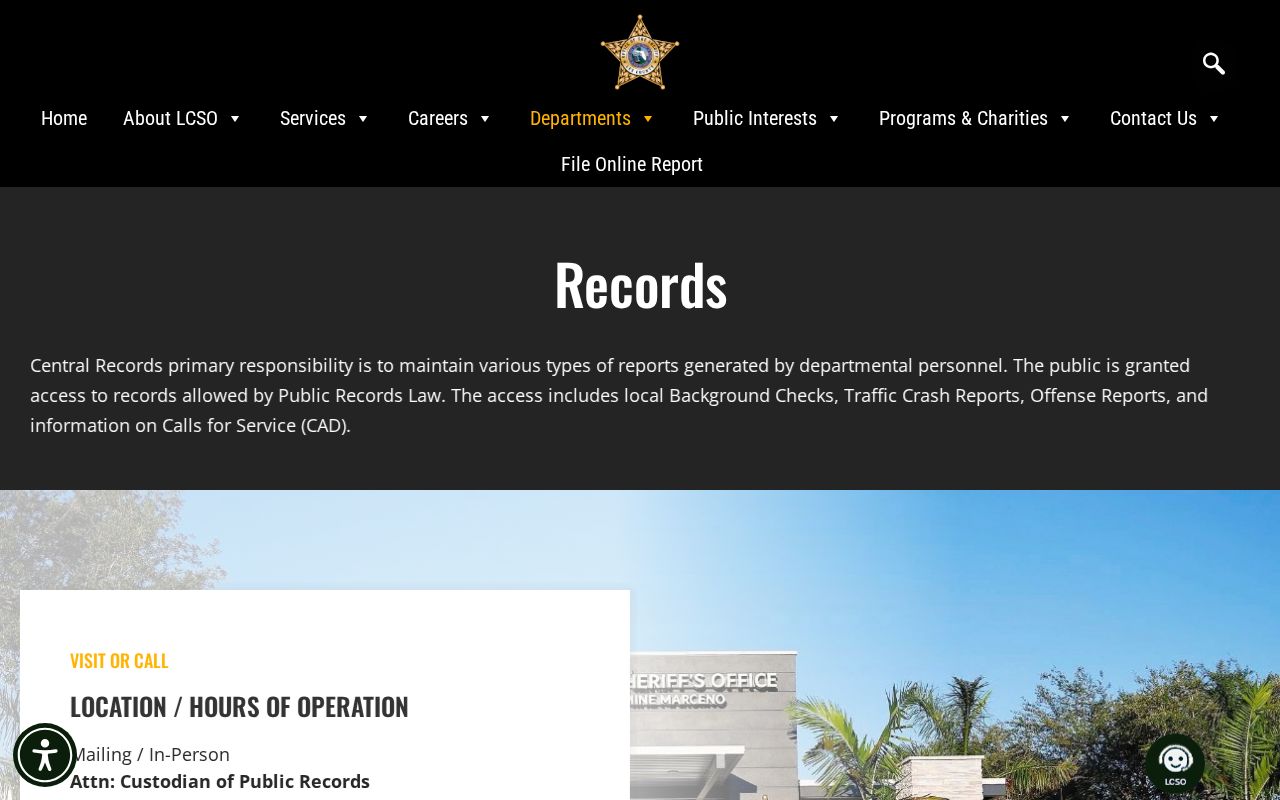
LCSO Central Records is the formal fallback for a sheriff report that cannot be retrieved from a recent online view. The office is at 14750 Six Mile Cypress Parkway, Fort Myers, FL 33912, and its phone is 239-477-1350. Requests can be made through the linked online portal, at headquarters, or discussed by phone.
The sheriff’s records page is the source for the local request channel and contact point.
Give the incident or report number when known, plus the date, approximate time, location, agency or unit, and a narrow description. Ordinary paper copies are listed at $0.15 per page. Victims and involved crash parties may present government ID for a fee waiver. Large requests can incur a special service charge and deposit.
LCSO Central Records
14750 Six Mile Cypress Parkway
Fort Myers, FL 33912
239-477-1350
What an Arrest Record Shows
A Lee County booking entry joins intake facts to the charges asserted at that moment. The related incident report may add the narrative and probable-cause facts, subject to redaction. Neither record states the final result unless a later source has supplied that disposition.
| Booking Number | The local identifier for the custody event. |
|---|---|
| Booking Date & Time | When LCSO intake recorded the person. |
| Arresting Agency | LCSO, a city police department, or another agency. |
| Charges | Allegations entered at booking, which may differ from filed charges. |
| Bond | Amount or hold status shown at that stage. |
| Booking Photo | An intake image subject to Florida disclosure limits and agency policy. |
| Release Status | Current custody, release, or transfer data when the system is updated. |
Florida law restricts public release of many booking photographs when the person is charged with a nonviolent offense. Exceptions can apply, including when release aids a law-enforcement purpose or the person is a fugitive. The official record, not a third-party gallery, is the proper source.
Lee County Arrest Search Differences
LCSO also publishes an official arrest search. The booking and arrest tools overlap, but the safest approach is to read their labels and date scope rather than assume both indexes cover the same span. A current jail view answers who is in custody now; an arrest result may focus on the event.
| Search field | Use |
|---|---|
| First, Middle, Last Name | Find and narrow a name match |
| Date of Birth | Separate people with similar names |
| Booking Number | Locate one exact intake event |
| In Custody | Choose all, yes, or no |
| Booking or Release Range | Limit results by event dates |
The official arrest interface illustrates why readers should stay with the sheriff’s own source.
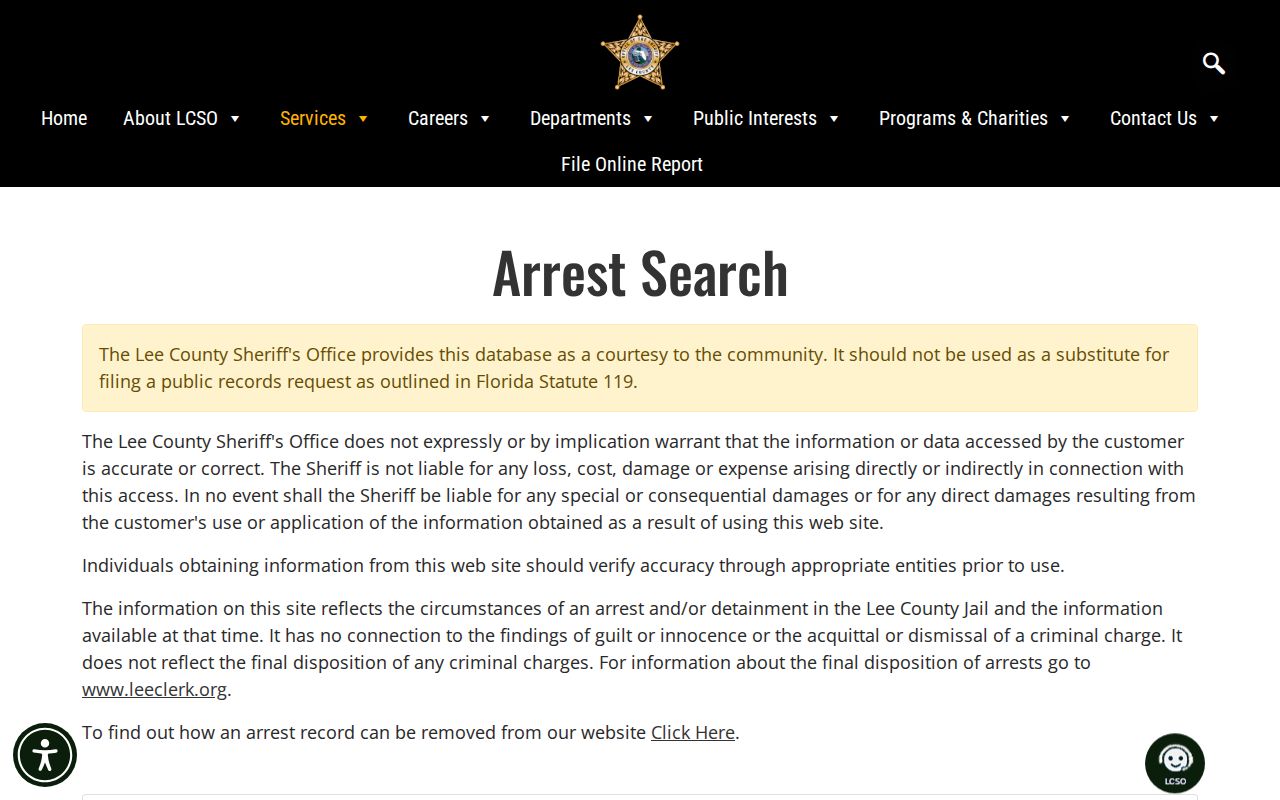
Republished names and photos can remain online after an official record changes. Verify the event with LCSO, then use the Lee Clerk’s court file to check whether a prosecution followed.
LCSO labels the database a courtesy rather than a substitute for a chapter 119 public-record request. Its notice also says the entry reports arrest or detention circumstances, not a finding of guilt, innocence, acquittal, or dismissal. Quick filters cover Recent Bookings and Recent Releases, while the result list identifies name, date of birth, booking number, and status. Those limits make Central Records and the Clerk essential when the question goes beyond the displayed custody event.
Recent Arrests and Booking Logs
Recent Lee County arrest logs are time-sensitive. Intake data can appear before a first appearance, and release or transfer data can change soon after. A person may also be booked on several charges that prosecutors later consolidate, amend, or decline. Save the booking number and date if you need to trace the event into the court system.
The LCSO Corrections Bureau explains the county custody setting behind those entries.

A roster is not an archive. Absence can mean release, transfer, a different spelling, a protected record, or that the event falls outside the displayed period. Contact Central Records when the event is too old or the index is unclear.
How Lee County Arrests Reach FDLE
LCSO booking captures fingerprints and sends the linked arrest data through Florida’s criminal-justice network to the Florida Department of Law Enforcement. FDLE then creates an arrest cycle in its Computerized Criminal History file. Prosecutors and courts later report filed charges and outcomes back through agency systems. A delayed or unmatched disposition can leave the state history less complete than the Clerk file.
The FDLE instant search costs $24 plus a $1 card fee and is not certified. It is a name-based public product, not a fingerprint-confirmed identity match. Certified and non-certified mailed searches are available through SHIELD. For review of your own record, fingerprints and certified Lee County dispositions can help resolve a mismatch.
Lee County Arrest Request Portal
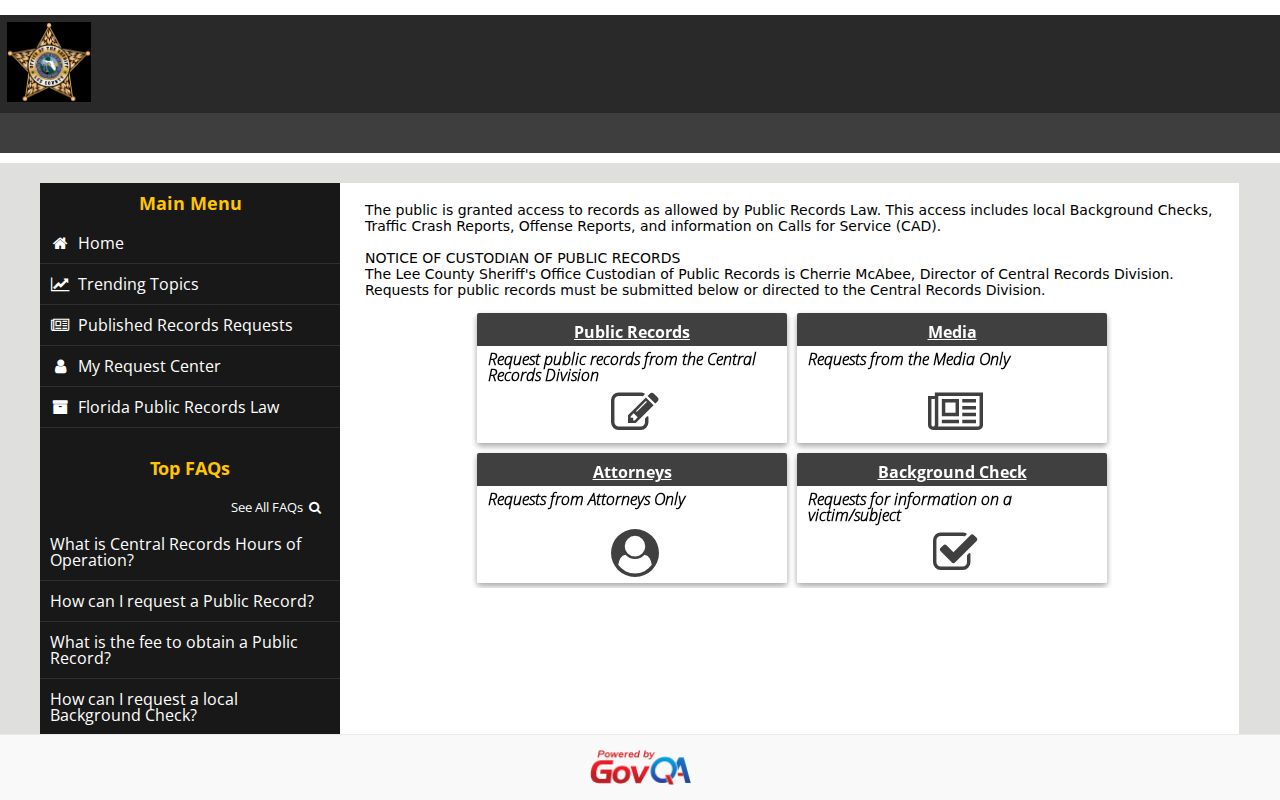
A narrow request is faster to identify and easier to estimate than a demand for every record tied to a common name. The LCSO public-record portal asks for contact and delivery details along with the record type, event facts, and description. Upload qualifying identification only when a documented waiver or access rule calls for it.
The portal screen is the county’s official electronic route for a request.
Active-investigation facts, juvenile material, protected victim details, and security-sensitive content may be withheld or redacted. Crash reports have a separate rule: general disclosure is restricted for the first 60 days, though involved drivers and their legal representatives may request an available report.
Arrests vs Convictions
The arrest and the conviction are created at different stages by different custodians. One proves that a booking occurred. The other records a court finding or plea. To follow a Lee County arrest into the filed charge and final result, use Lee County criminal court case records and read the disposition count by count.
| Arrest Record | Conviction Record |
|---|---|
| Created by an arresting agency and LCSO booking | Created through the court and maintained by the Clerk |
| Shows custody and booking allegations | Shows a plea or finding of guilt and the sentence |
| Lives in agency, jail, and FDLE systems | Lives in the case file and reported state history |
| May lead to release, no filing, or dismissal | May lead to sentence, appeal, sealing, or other relief |
Note: An arrest is not proof of guilt, and a booking may never lead to a filed charge or conviction.
When sources disagree, prefer the originating office for each fact. LCSO can confirm booking data, the arresting agency controls its report, and the Lee Clerk can certify the court outcome.
A dismissal or acquittal does not make the earlier booking entry false; it changes how that event must be understood. The booking proves custody on a stated allegation, while the Lee County court disposition supplies the later legal result. If a public state history lacks that result, keep the FDLE transaction details and obtain a certified disposition from the Clerk. FDLE may need that source record, and sometimes fingerprints, to review a disputed or incomplete arrest cycle. Qualifying records can also be sealed or expunged under Florida law, which changes ordinary public access but does not turn an old unofficial copy into a reliable current source.