
How to Check Criminal History in Cape Coral
Cape Coral records have three main custodians. The police department owns the city incident or offense report. The Lee County Sheriff’s Office owns the booking and custody record after transport to central booking. The Lee County Clerk owns the court case once prosecutors file charges. A complete search follows that sequence instead of assuming one search contains every stage.
- Identify whether Cape Coral Police created the event report.
- Request that report through the city’s records channels with a date, place, and report number when known.
- Check LCSO booking data for custody, booking charges, release, and bond facts.
- Search Lee Court Records Inquiry for the filed charge and disposition.
- Use FDLE when a statewide repository history is needed.
Begin with precise facts. A name alone can match more than one person. Dates of birth, event dates, addresses, report numbers, booking numbers, and case numbers help the custodian find the right Cape Coral criminal record.
Cape Coral Criminal Record Custodians
The same event produces separate records for separate purposes. A Cape Coral Police narrative describes the officer’s response and alleged facts. An LCSO booking entry documents intake and custody. A Lee Clerk docket tracks the prosecution, hearings, filings, and outcome. None should be used as a stand-in for the others.
| Record | Cape Coral route | What it answers |
|---|---|---|
| Police report | Cape Coral Police Records | What city officers documented |
| Booking record | Lee County Sheriff | Intake, booking charge, status, bond, release |
| Criminal case | Lee County Clerk CRI | Filed charges, events, documents, disposition |
| State history | FDLE criminal-history search | Repository records reported from Florida agencies |
This comparison prevents a common error: asking LCSO for a CCPD report simply because the person entered the county jail. Custody transfer does not transfer ownership of the police narrative.
Cape Coral Police Records
The Cape Coral Police Department is the city custodian for reports its officers create. Police Records can be reached at 239-574-3223. A focused request should name the department, date range, incident or report number, location, people involved, desired format, and a clear description. Attachments can help when they identify the event without broadening the request.
The city offers more than one public-record channel. Requests may be submitted online, by email, by phone at 239-574-0411, or in person at 1015 Cultural Park Boulevard, Cape Coral, FL 33990. The public counter is open Monday through Friday, 7:30 a.m. to 4:30 p.m. Police report questions should still be routed to Police Records, since the general city custodian also handles many non-police departments.
Cape Coral Police Records
Police-created incident and offense reports
239-574-3223
Cape Coral City Records
1015 Cultural Park Boulevard
Cape Coral, FL 33990
239-574-0411
Cape Coral Police Request Tracking
A 2025 city audit reports that CCPD adopted online records software in October 2023. The system lets requesters submit a request, communicate with staff, watch progress, and retrieve released files. That tracked workflow is useful when a Cape Coral report needs review or redaction and cannot be supplied at once.
The Records Division reports an average of about 1,000 public-record requests each month. Specific dates and report identifiers can reduce search time in that volume. The official Cape Coral records-routing page also sends users to Lee Clerk for court records and LCSO for criminal-history or booking records, reinforcing the three-custodian split.
Request tracking does not make every police file public. Staff still review responsive material for Florida exemptions and apply redactions when required. A status message may show that work is in progress, that the city needs clarification, or that records are ready. Reply within the portal when the department asks for a tighter date range or clearer incident description. That exchange keeps the request tied to its original tracking history.
The city’s records page shows those local routes.
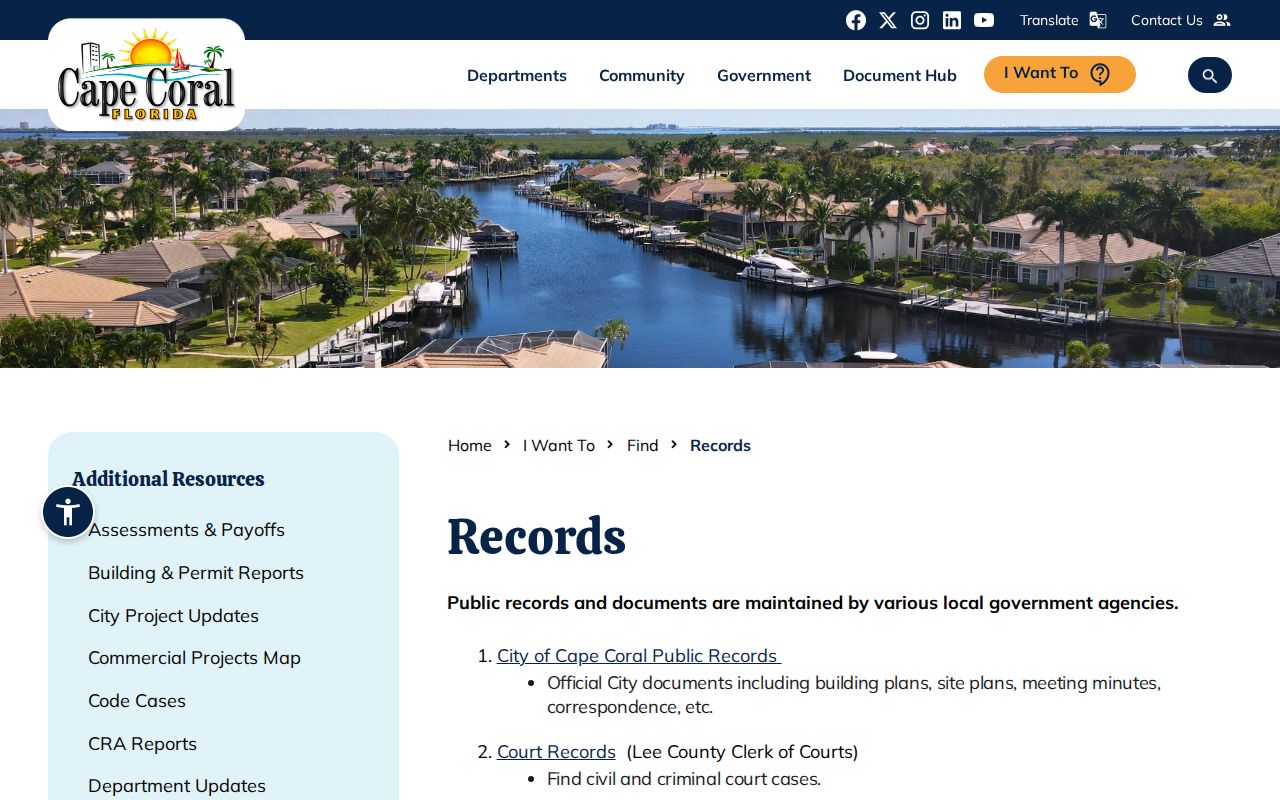
It is the best city-level starting point when the requester knows the subject but not the correct custodian.
Arrests and Bookings in Cape Coral
Cape Coral Police may make the arrest, but custody normally enters LCSO central booking. The county booking search can show a recent intake, booking number, custody status, listed charges, bond, and release information. A booking charge is an allegation. It is not the final charge or a finding of guilt.
If the city report is visible but no booking appears, check the event date and allow for intake delay. Then contact the jail or search with stronger identifiers. The person may have been cited, released through another process, or entered under details that differ from the first query. Do not infer a case outcome from a missing result.
For a full walkthrough of filters and custody limits, use the Lee County arrest history resource. Cape Coral readers can then return to CCPD for the narrative and the Clerk for the prosecution.
Cape Coral Arrest Record Timeline
The local timeline is easy to lose when search screens show only snapshots. First, a Cape Coral officer creates an incident or arrest report. If there is a custodial arrest, the person is transported into LCSO booking. Prosecutors then decide what to file, and the Lee Clerk creates or updates the criminal docket. FDLE receives reportable information later in the process.
Local timeline: Cape Coral Police report › LCSO central booking › prosecutor filing decision › Lee Clerk case › FDLE repository update.
The records can disagree without any office making an error. A booking log may preserve the arresting officer’s initial charge while the filed information uses a different charge. A Clerk disposition is the better source for the outcome.
Cape Coral Municipal Court Records
Cape Coral does not have a separate municipal criminal docket like cities in some states. Florida County Court and Circuit Court handle criminal and ordinance matters within their jurisdiction, and the Lee County Clerk maintains those files. City civil citations or administrative hearings should not be confused with a state criminal prosecution.
| Court name | Lee County Court or Circuit Court, depending on case type |
|---|---|
| Case types heard | County Court handles misdemeanors and qualifying ordinance matters; Circuit Court handles felonies |
| Case lookup channel | Lee Court Records Inquiry online or Lee Clerk service channels |
| What the docket shows | Filed charge, parties, events, available documents, and disposition |
| Local access point | Limited-services Lee Clerk branch at 1039 SE 9th Place, second floor |
Searchers should not stop at a city civil citation system when the issue is criminal. Use the Lee criminal docket and select the relevant case type, including Misdemeanor, Adult–Felony, County Ordinance, Municipal Ordinance, or CriminalTraffic.
Cape Coral Criminal Records Branch
The Lee Clerk maintains a limited-services branch at 1039 SE 9th Place, second floor, Cape Coral, FL 33990. It gives city residents a closer access point than downtown Fort Myers for supported services. Call 239-533-5000 before travel to confirm that the desired criminal-record task is offered at the branch.
“Limited services” is the key phrase. A hearing may occur at a court location, while copies or certification are handled through Clerk customer service. Some records can be found through CRI before a visit. Restricted, sealed, juvenile, and confidential information will not become public merely because a requester appears in person.
Practical sequence: search CRI, note the case number, call the branch about the needed service, then bring the identifiers required for copies or file review.
Where Cape Coral Records End Up
A city police report remains with CCPD, even as facts from the event enter county and state systems. LCSO keeps the booking record. The Lee Clerk holds the filed court case. FDLE’s central repository receives qualifying criminal-history data from reporting agencies. This is a flow of information, not a transfer of every underlying document.
Record flow: Cape Coral Police Department › Lee County Courts › Florida Department of Law Enforcement.
Recent activity is often most detailed at the local source. Older processed matters may be easier to trace through the Clerk and FDLE. A person reviewing their own Cape Coral record should compare identifiers and dispositions across those layers, then request a correction from the agency responsible for the wrong field.
Cape Coral Record Copy Fees
Cape Coral’s published city fees distinguish paper, media, and electronic delivery. Electronic delivery is normally free, while a request that requires extensive staff time can carry an additional charge. Ask for an estimate when the request has a wide date span, many locations, video, or substantial review needs.
| City record format | Published amount |
|---|---|
| One-sided paper copy | $0.15 per page |
| Double-sided paper copy | $0.20 per sheet |
| CD | $1 |
| DVD | $1.50 |
| Electronic delivery | Normally free; extensive staff time may be charged |
These are city copy terms. LCSO and the Lee Clerk maintain their own fee rules for the records they hold. Sending the request to the right custodian is therefore both a records issue and a cost issue.
Cape Coral Record Jurisdiction
Cape Coral has more than 400 miles of canals. That geography can affect which agency creates a marine, traffic, crash, or incident record. The city police department may be the custodian for a local event, while a state-road crash investigated by the Florida Highway Patrol follows FLHSMV or FHP channels. The location alone does not prove that CCPD owns the file.
Look for the agency name, badge information, report number prefix, or exchange-of-information form. If those clues are missing, give the city the exact location and date and ask whether its records unit is the custodian. A precise routing question is more effective than sending the same broad request to several offices.
Crashes show the issue in plain terms. CCPD can hold a city-police crash record, while FHP material follows the state channel. Marine calls can also involve facts that do not fit a street-address search. Provide the canal, nearby cross streets, dock or property address, and time window when known. These details help Cape Coral staff identify the responding unit before they search for responsive records.
The official Cape Coral profile provides city context.
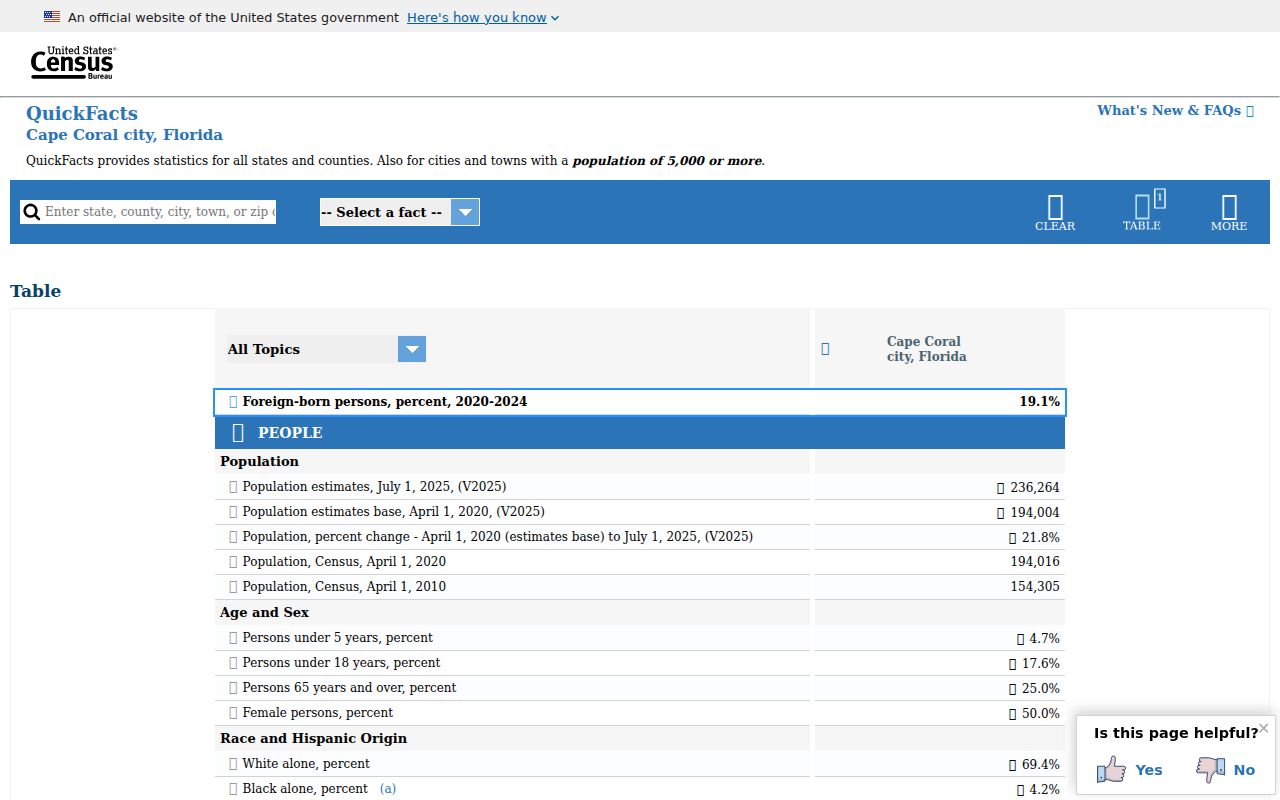
Cape Coral’s size and canal network make accurate agency identification especially useful for local record requests.
Public Access Rules for Cape Coral Records
Florida’s Constitution and chapter 119 establish broad access to government records, but exemptions protect specific information. Cape Coral may redact protected personal data, active investigative details, victim information, juvenile material, or other content covered by law. The office should identify the basis for a withholding or redaction.
Criminal-history dissemination also has separate rules. A city incident report is not the same product as an FDLE repository check. Sealed and expunged records have access limits, and a public portal may omit confidential material by design.
Key Statutes:
Florida Constitution, Article I, section 24 establishes the public right of access, subject to exemptions.
Florida Statute 119.07 governs inspection, copies, fees, and exemption handling.
Florida Statute 943.053 governs dissemination of criminal-history information.
Describe the record, not a legal conclusion. Names, dates, locations, and report numbers let Cape Coral staff search with less guesswork while preserving the requester’s right to ask for an existing public record.